


Julia Chivu ’23
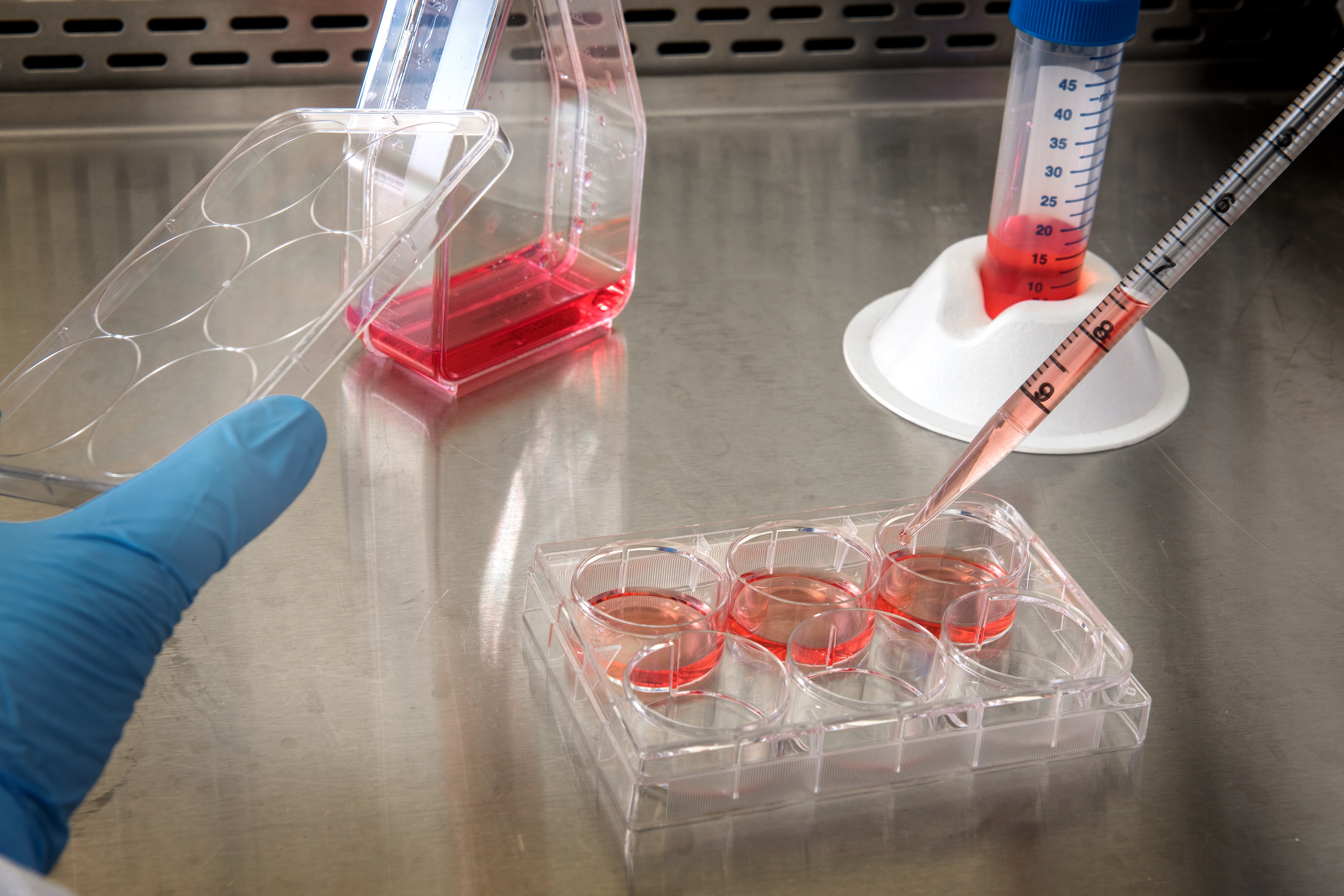
Figure 1 Scientist with blue gloves adding hot pink cell growth medium using a transfer pipette into a six-well plate, with culture flask and centrifuge tube also filled with hot pink cell growth medium in the background.
Biomanufacturing is a field of study which produces various biotechnology-based products including vaccines, biofuels, and genetically modified crops by using living organisms and cells. The cells are typically cultured in bioreactors, devices designed to replicate the ideal environment for cell production and development. The cultivation of these cells is necessary for growing demand, but is often challenging due to costliness, limited yield capacity, and lengthy production times. A research team led by scientists from various departments at Stony Brook and other universities hypothesized that Low-intensity Vibration (LIV) could address these challenges while maintaining cell functionality and viability.
The research team conducted experiments using a feedback-controlled device to deliver LIV signals to Chinese hamster ovary cells (CHO) and human T-cells, both suspended and adherent, to identify their cell growth rates. Suspended cell types were desired to be compared to adherent cells, which attach themselves to their substrate, to better understand if the cell types would react to LIV in a similar manner. Chinese hamster ovary cells were used because they could be cultured as suspension or adherent cells, and are widely used in the biotechnology industry. In addition, human T-cells were included to see if other kinds of suspension cells would respond to LIV signaling. Multiple experiments ran during this study that involved the cells from these three culture types to be plated and grown for brief periods of time. This was followed by the provision of various signaling parameters and cell counting methods to determine the optimal growth rates for each type of cell.
It was found that all of the cell types responded positively to LIV, though the growth rate of each cell type was dependent upon the duration, intensity, frequency, refractory period, and daily doses of LIV. For example, the best settings for making the CHO-suspended cells grow were drastically different from those for the CHO-adherent cells; the optimal growth frequency for the CHO-suspended cells was 30 Hz, whereas it was 500 Hz CHO-adherent cells. The research team also suggested that since the LIV signaling method was able to effectively influence the cells through various culture media, that tool could be used with the existing bioreactor cultivation devices. Further experimentation with this technique could allow for a wide range of pharmaceutical, agricultural, and industrial products to be developed that can benefit society.
Works Cited:
[1] M. Ete Chan, et al., Low intensity mechanical signals promote proliferation in a cell-specific manner: tailoring a non-drug strategy to enhance biomanufacturing yields. bioRxiv (2023).
[2] Image retrieved from: https://unsplash.com/photos/N3yNsmTSu90.
 Young Investigators Review