Maria Sazonova ’26

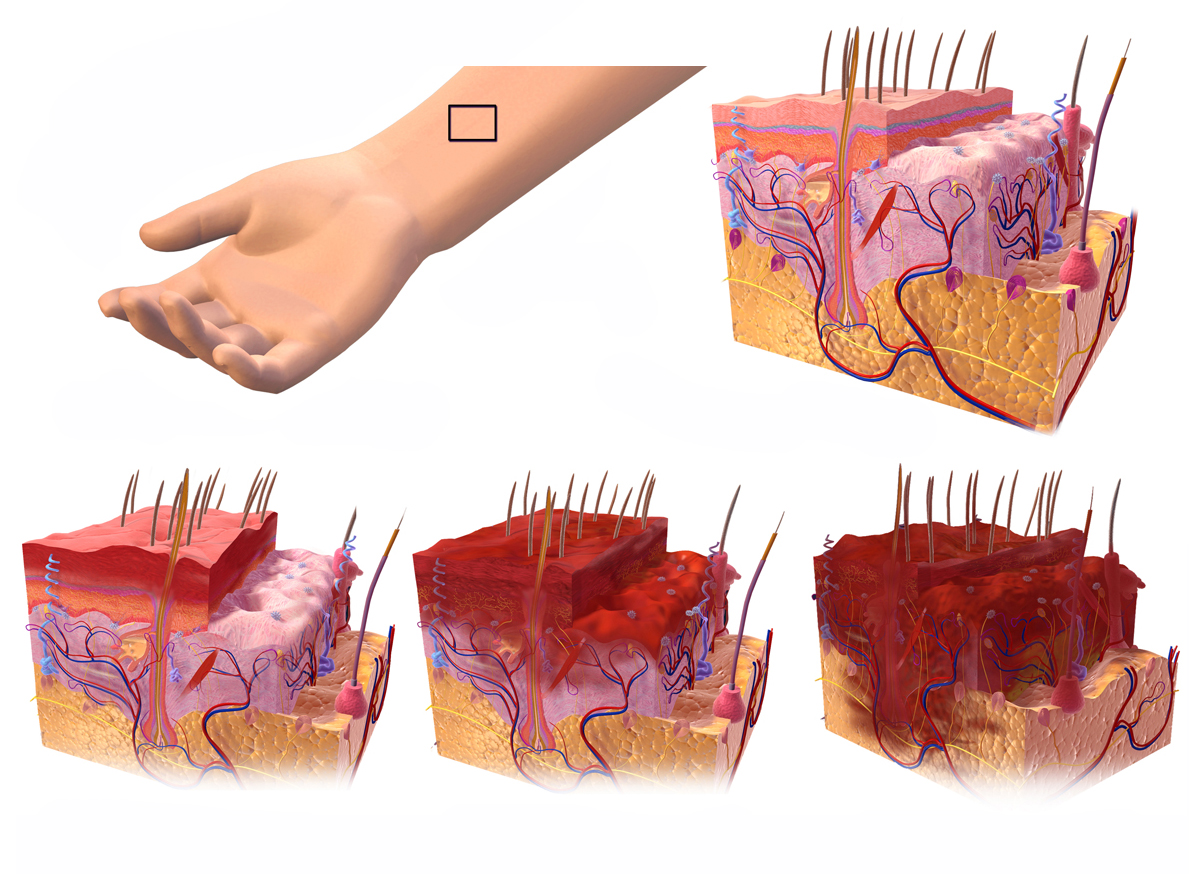
Burn injuries can result in significant skin necrosis and deep tissue damage. Severe skin burn injuries are dynamic and hard to predict; therefore, initial assessment is paramount because it forms the basis for a subsequent treatment plan. A group of Stony Brook University scientists led by M. Hassan Arbab, funded by The National Institute of General Medical Sciences, created a neural network algorithm that modeled the permittivity of burned tissue and classified it according to severity.
Burn depth was estimated based on biopsies collected from burn sites in the post-burn period within 24 hours of burn induction. The model predicted the injury’s healing outcome by forecasting the status of its re-epithelialization – the process of creating a cell barrier between wound and environment – after 28 days. Forty burns of various severities were inflicted on the dorsum of two Landrace pigs using a metallic brass bar and a hot water scald, which represent the sources of many clinically relevant burn injuries. If a burn was fully-re-epithelialized on Day 28, it was placed into the fully-healed (FH) category, while all other burns were categorized as not-healed (NH) and requiring surgical intervention. This process was repeated 100 times, with control groups included in test groups at each iteration.
Clinical diagnosis of intermediate burns is a highly subjective evaluation, with a 60–75% accuracy rate in diagnoses. The neural network classification algorithm improved this to 93% accuracy for correct wound healing process prediction and 84.5% accuracy for estimated burn severity classification. The findings of this study also allowed Arbab et al. to develop a portable, user-friendly, handheld imaging device named the PHASR (Portable Handheld Spectral Reflection) Scanner, for fast and non-invasive spectroscopic imaging measurements. It uses terahertz time-domain spectroscopy (THz-TDS), considered safe for the body, to estimate burn severity and depth in a timely manner and assess if the patient needs to be referred to a burn specialist immediately or can be managed by non-burn specialists. This device gives accurate burn depth assessments that guide surgical treatment plans and reduce the length of hospital stays, minimize unnecessary surgical procedures, and improve rehabilitation. As such, this device has potential applications in clinical settings, including emergency rooms. Future studies may investigate other techniques for more reliable burn depth determination. Supplemental testing of the PHASR device and THz-TDS technique is also needed before integration into clinical burn assessment practices.
Works Cited
[1] M. H. Arbab, et al., Triage of in vivo burn injuries and prediction of wound healing outcome using neural networks and modeling of the terahertz permittivity based on the double Debye dielectric parameters. Optica Publishing Group 14, 2 (2023) Doi: 10.1364/BOE.479567
[2] Image retrieved from: https://upload.wikimedia.org/wikipedia/commons/2/27/1st%2C_2nd%2C_and_3rd_degree_burns.jpg
 Young Investigators Review