

Author: Amal Bilal, Class of 2028
Artificial Intelligence (AI) is emerging as a tool that can be leveraged to identify effective solutions for the current biodiversity crisis. As ecosystems are increasingly harmed by humanity, researchers are looking for ways in which AI can be used to create multimodal models that analyze ecological data to improve biodiversity loss predictions, track patterns in wildlife trade, and develop solutions to human-wildlife conflicts. Researchers believe that the adoption of AI in conservation and careful measures will lead to beneficial outcomes for conservation effectiveness and ensure equitable access, development, and deployment of these technologies to improve our natural world.
AI’s ability to handle large datasets, detect patterns, and uncover new information illustrates its potential for advancing conservation and ecological advancements. To identify the areas where AI has the most potential to revolutionize conservation efforts, Professor Sam Reynolds at Cambridge University and his colleagues held discussions between an international panel of 27 conservation scientists and AI experts. 21 key issues were found to significantly affect the success of global biodiversity conservation. These issues include novel interpretation of image and audio data, digital twins for ecosystems, improving species distribution models, and AI-powered conservation advisors. The study emphasized the value of combining diverse datasets, such as remote sensing imagery and environmental DNA, to generate insights into species distributions and threats. AI technology can help track deforestation, predict human-wildlife conflicts, and enforce conservation laws more efficiently than traditional methods.
However, researchers have some concerns about the use of AI in conservation. Researchers acknowledge the potential for unintended negative consequences and the importance of understanding and mitigating these possibilities. For example, AI colonialism may lead to a loss of traditional conservation skills, high energy demands, biased datasets, and potential misuse. To counter these risks, the research team explains the necessity for interdisciplinary collaboration, human oversight, and equitable access to AI resources. Ultimately, the team highlights that while AI cannot replace currently established conservation efforts, using AI ethically could accelerate the progress of wildlife conservation, deepen understanding of our ecosystems, and help achieve global biodiversity goals.
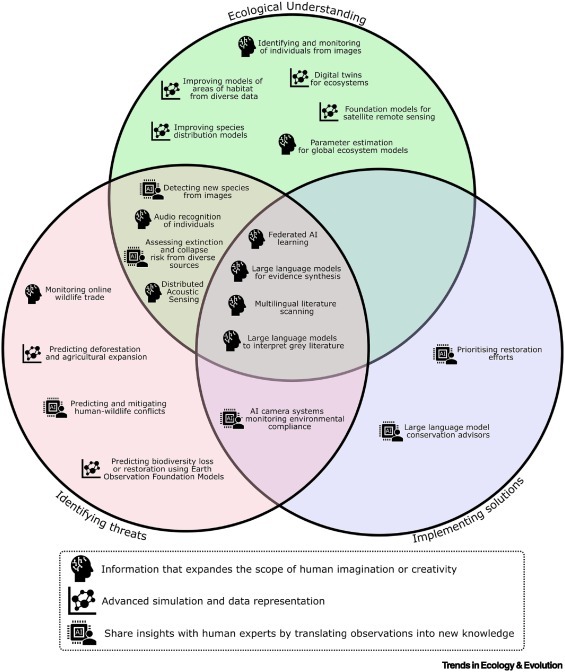
Figure 1. The 21 artificial intelligence (AI) applications identified by an international panel of conservation scientists and AI specialists.
Works Cited:
[1] Reynolds, S., Beery, S., Burgess, N., et al. (2025) The Potential for AI to Revolutionize Conservation: A Horizon Scan. Trends in Ecology & Evolution, vol. 40, no. 2, February 2025, https://doi.org/10.1016/j.tree.2024.11.013.
[2] Image retrieved from: https://www.sciencedirect.com/science/article/pii/S0169534724002866?ref=pdf_download&fr=RR-2&rr=98753a7c59c49f3b
 Young Investigators Review