

Author: Diego Javier, Class of 2026
In nature, color is used by animals as a defense mechanism to ward off predators, signifying whether they are poisonous or dangerous to eat. This type of warning coloration is known as aposematism, a strategy seen across many species including monarch butterflies and isopods, tiny crustaceans that hide under damp soil and rocks. This idea was explored by Professor Ivan Tuf and researchers at Palacký University in the Czech Republic who sought to determine whether isopods also use color as a means to warn potential predators.
The researchers tested this by painting yellow spots or gray spots on a species of common rough terrestrial isopods, or woodlice, known as Porcellio scaber. Yellow spots were painted to mimic warning signals, while gray spots were used to help the isopods blend in with their environment. These painted isopods were then released into a controlled environment containing Italian wall lizards (Podarcis siculus), small visual predators reared in captivity with no prior experience with isopods, ensuring their responses were based on color cues rather than familiarity. The team then carefully observed how the lizards responded by watching whether they looked at, chased, bit, or ate the isopods to determine if color affected the lizards’ behavior.
The researchers found that color alone didn’t make the woodlice completely safe, but it did change how the predators behaved. When the lizards interacted with the yellow isopods, they spent more time watching them. This suggests that the lizards hesitated in their decision-making, taking time to decide if these isopods were safe to eat. Gender also played a role in the results, with female lizards being more curious and consuming more prey, regardless of color. However, there was a decline in isopod consumption over time. This suggests that isopods were distasteful, likely due to the woodlice’s chemical defenses that produce an unpleasant odor and ammonia vapor. This study emphasizes that even a small, overlooked creature like an isopod is multifaceted in its survival strategies, which go beyond camouflage. Although bright colors did not make them immune to danger, it can work in tandem with chemical defenses to discourage predators. The study also reveals how a predator’s behavior changes through learning and experience. Future work could examine how different colors, environments, and predators influence these interactions, deepening our understanding of how visual and chemical cues evolve together. Overall, the findings highlight how every organism contributes to evolution, where survival depends not only on physical traits but also on adaptation, communication, and learning.
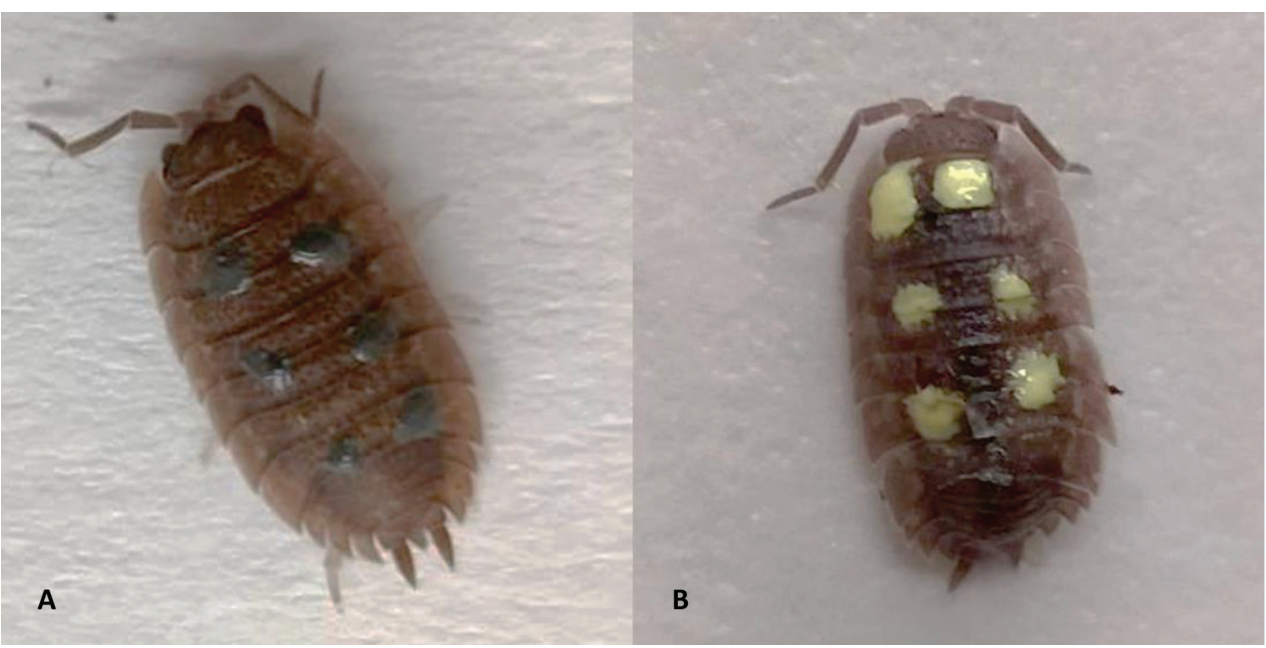
Figure 1. Two common rough isopods (Porcellio scaber) used in the experiment. (A) Isopod painted with gray spots to represent cryptic coloration, and (B) isopod painted with yellow spots to mimic aposematic, or warning, coloration.
Work’s Cited:
[1] Skočková, L., Ďurajková, B., & Tuf, I. H. (2025). Predator responses to artificial aposematic and cryptic colouration in terrestrial isopods (Isopoda, Oniscidea). ZooKeys, 1225, 141–153. https://doi.org/10.3897/zookeys.1225.121574
[2] Image retrieved from: https://doi.org/10.3897/zookeys.1225.121574
 Young Investigators Review