

Author: Maegan Diep, Class of 2029
The beneficial effects of music are garnering attention for their healing abilities and their impacts on physiological and psychological states on humans and animals alike. Research has implicated music in stress alleviation in laboratory animals, improvements in egg production and hatchability in quails, and extended resting periods in pigs. Cows, in particular, are currently being studied for their productivity in milk production and other welfare characteristics, such as anti-stress indicators and immune functions.
Furthering the understanding on the effects of different music genres, a recent study investigated the effects of Raga music and Chinese five-element music on 60 Holstein cows from the Branch Cattle Farm of Beijing Shounong Animal Husbandry. The cattle were divided equally into three groups: one control group exposed to no music, one experimental group exposed to Raga music, and one experimental group exposed to Chinese five-element music. The trial had a seven-day pre-test period before the 60-day experimental period, where feeding (based on a basal diet) occurred before music at specified times throughout the day. Music was played consistently for nine hours every day at the same volume through evenly-spaced players with no external noise interference.
Throughout the experiment, several key factors, such as milk output, health markers, and stress hormones, were recorded daily. Milk yield was recorded automatically at set times using a milking system, and samples were collected for analysis. Additionally, feed intake and leftovers were recorded to calculate the average feed consumption. Welfare parameters (i.e., activity levels, resting time, rumination duration) were also continuously monitored via accelerometer collars. To gauge further information, specialized kits were used to analyze blood samples, the antioxidant index, and immunologic function; analyzers were used to study the neuroendocrine index.
In comparison to the control group, data revealed that cows in both the Raga and Chinese five-element music experimental groups produced more milk and demonstrated a lower feed-to-milk ratio–indicating improved efficiency in converting feed to milk. In contrast to other forms of treatment, Raga-exposed cows particularly reflected the calming effect brought about by carnatic music: Neuroendocrine and stress-related markers were better regulated and activity levels were reduced. In addition, both experimental groups demonstrated increased IgM, IgG, and IgA levels, key molecules of immune function. Utilizing the unprecedented Raga and Chinese five-element music on cows, this study builds on the current level of understanding regarding music therapy. Additional research focusing on a larger scale and a longer time period would be needed to better grasp and confirm the true potential of music therapy.
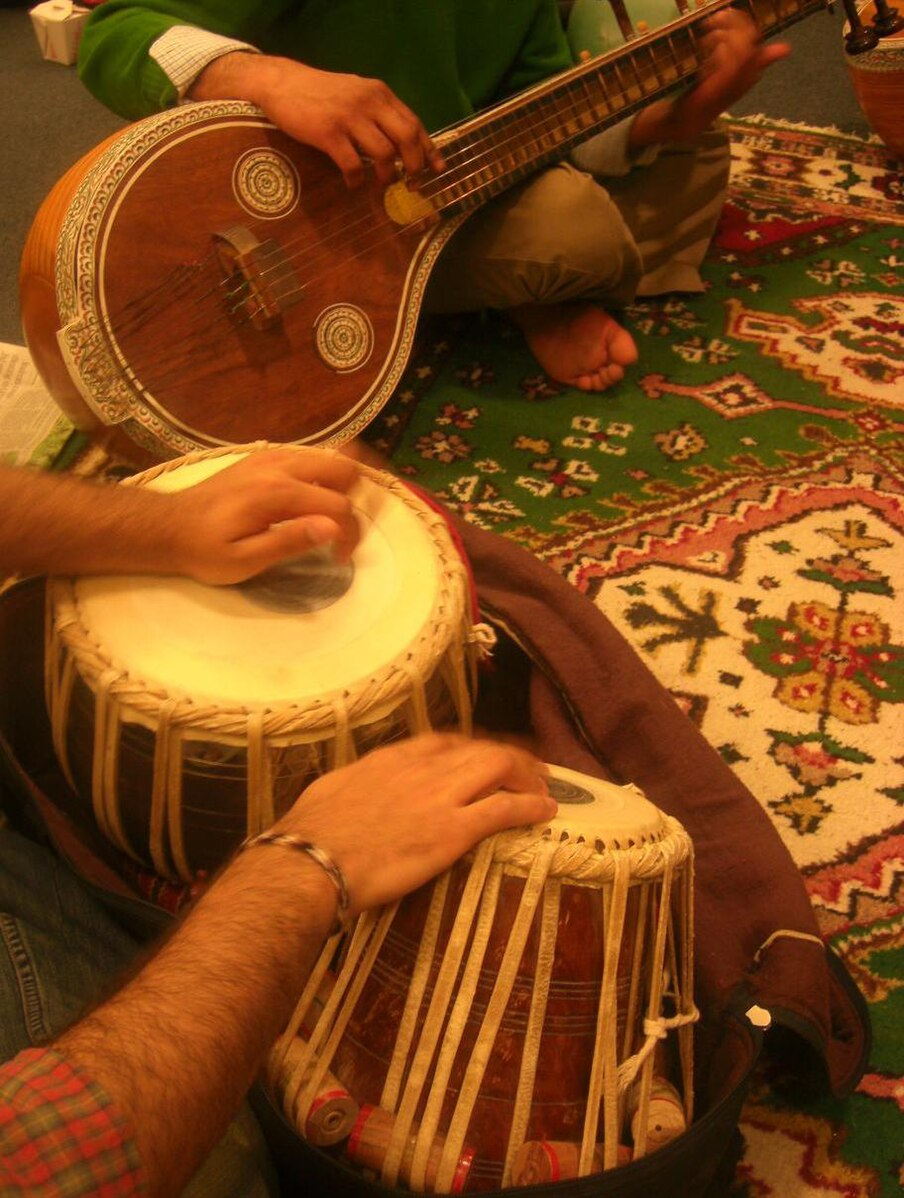
Figure 1. An image of raga instruments.
Works Cited:
[1] Cao, Z., Zhao, H., Feng, Z., Yang, B., Li, Z., Ma, X., Gu, S., & Ma, N. (2025). Effects of Raga music and Chinese five-element on milk production, antioxidant, neuroendocrine, immune, and welfare indicators in dairy cows. Frontiers in Veterinary Science, 12(29). https://doi.org/10.3389/fvets.2025.1623026.
[2] Image retrieved from: https://commons.wikimedia.org/wiki/File:Jammin%27_it_up_%282404459238%29.jpg
 Young Investigators Review
