


By: Kimberly Johnston, Class of 2026
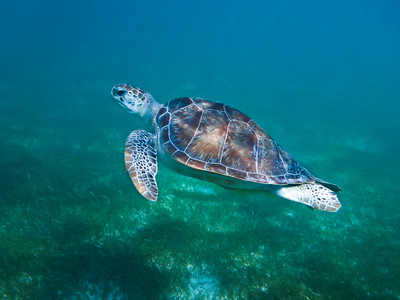
Figure 1: A marine turtle
Adult female marine turtles alternate between foraging and nesting phases, with periods of migration in between. Monitoring programs typically obtain data for only part of the nesting season due to a lack of financial support, remote beaches, or a large number of beaches to monitor. To accurately assess population trends, a model must be used to reconstruct the nesting season. This information must be unbiased because it is used to prioritize actions and allocate funds for conservation. Utilizing an appropriate model is essential to obtain unbiased estimates of phenology for each nesting season and an accurate number of female emergences or nests.
A study led by Marc Girondot aimed to develop a statistical model that would distinguish between year-round nesting and overlapping nesting seasons. Three datasets (green turtles in D’Arros Island, Seychelles, and leatherbacks in Yalimapo Beach, French Guiana, and Northwest Coast of Papua, Indonesia) represented different nesting patterns. The study demonstrated that in a year-by-year analysis, the parameters of each nesting season appear to be biased when two nesting seasons overlap. The solution is to use a model of nesting that can represent multiple nesting seasons in a single model. This can be done by performing a single analysis that estimates the shape and scale of all annual peaks.
Rising sand temperatures can affect hatching success rates and sex ratios through temperature-dependent sex determination, wherein higher incubation temperatures result in more feminized embryos. Understanding how phenological shifts in nesting (changes in the timing of nesting events) may offer adaptive responses for these populations is crucial. The model created in this study is an essential tool for understanding the seasonal bimodal nesting behavior of marine turtles in the context of climate change.
Citation:
[1] Girondot, M., Dejoie, A., Charpentier, M. “The mystery of bimodal nesting seasons in marine turtles.” Ecological Modelling (2024) doi: https://doi.org/10.1016/j.ecolmodel.2024.110653
[2] Image retrieved from: https://www.flickr.com/photos/alan_graf/8847735976
 Young Investigators Review