

By Ilian Medarov, Class of 2028
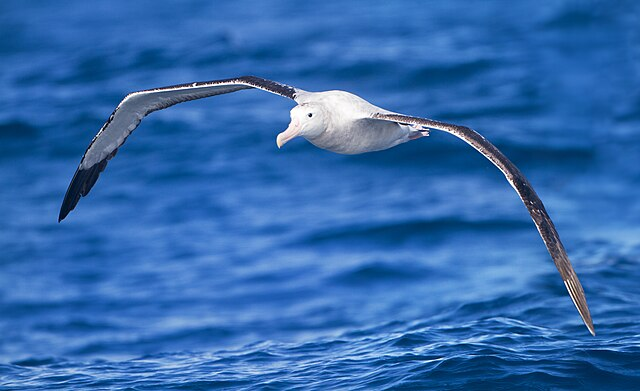
Figure 1:Wandering Albatross
Seabirds are important members of our ocean’s ecosystem, and when foraging, they exhibit spatial segregation that can expose them to environmental threats. Understanding these segregation patterns is vital for conservation, especially in endangered populations or those that are on the decline.
V. Warwick-Evans and colleagues aimed to figure out if the differences in the population decline between colonies of wandering albatross at South Georgia could be explained by this spatial segregation and its overlap with fisheries. The hypothesis was that different colonies would forage in different locations, leading to unequal bycatch risk and different population trends for the colonies.
To figure this out, the researchers tracked the birds from two nearby breeding sites, Prion Island and Bird Island, during 2022’s breeding season. They used GPS loggers and satellite transmitters to follow the paths of their foraging trips across the Southern Ocean. Additionally, they applied species distribution models to determine habitat preferences, and analyzed wind conditions at departure to view environmental impacts on the birds’ movement. The birds’ locations were also compared with fishing activity data to estimate fishery overlap and bycatch risk.
Despite the two colonies being less than 50 kilometers apart, the results showed significant spatial segregation between them. The Bird Island individuals foraged westward, while the Prion Island individuals foraged both eastward and westward. This separation was not explained by habitat preference or wind conditions; however, it indicates that other factors, such as learned behaviors or even cultural interactions, could be responsible. Analysis of the fisheries overlap showed that Bird Island birds had far more frequent interaction with longline and trawl fishing operations. This observation aligns with the more rapid population decline seen there, supporting the hypothesis that bycatch risk is a factor in the differing population trends.
This study shows that spatial differences in animal behavior, even at small scales, can have significant consequences for conservation. It exemplifies the importance of colony-specific management efforts and why uniformity cannot be assumed across populations. Future research could examine how social learning shapes these foraging behaviors and potentially other behaviors, and look into how mitigation strategies in high-risk fishing areas can be improved. Overall, these findings provide good insight for protecting these birds and other species that could be encountering similar threats.
Work’s Cited:
[1] Warwick-Evans, V., Pearmain, E. J., Thorne, L., & Phillips, R. A. (2026). Spatial segregation and bycatch risk as potential drivers of population trends of wandering albatrosses at South Georgia. Conservation Biology, 40, e70126. https://doi.org/10.1111/cobi.70126
[2] Image retrieved from: https://commons.wikimedia.org/wiki/File:Diomedea_exulans_in_flight_-_SE_Tasmania.jpg


