

Author: Maegan Diep, Class of 2029
Depression varies in traits and characteristics among individuals, making its causes and mechanisms difficult to treat. Though depression can be categorized into chronic and nonchronic courses, the issue of reliable diagnoses persists, as there is a lack of evidence in distinguishing the etiology and physiological processes of the condition. Thus, researchers from the Klein lab at Stony Brook University sought to better understand and distinguish chronic and nonchronic depression by investigating abnormalities in neuromelanin, a primary molecule associated with neurodegenerative disorders, via neuromelanin-sensitive magnetic resonance imaging (NM-MRI) contrast. Specifically, they studied the positive valence system (responsible for responses relating to reward-learning and consummatory behavior, which are predicted to affect extraversion) and the dopaminergic pathways (responsible for motivation, reward, and pleasure processes) associated with the midbrain.
After assessing and screening participants, a total of 105 women aged 20-24 years old underwent the NM-MRI study. 9 women had chronic depression, 28 women had nonchronic depression, and 68 women had no lifetime history of depression. Upon processing the NM-MRI data and statistical analysis, an association was found between the depression group and the NM-MRI contrast, where the contrast in the scans reflected the presence/lack of NM, an indicator of decreased dopamine functioning. The chronic depression group had a significantly lower contrast than the groups with nonchronic and no lifetime history of depression. The latter two groups did not differ from one another. Furthermore, the NM-MRI was observed to have a positive correlation with the extraversion trait, indicating a lower depression risk. Though extraversion has previously been linked with chronic depression in earlier studies, the documented relationship between the trait and dopamine function via NM-MRI contrast is novel. The evidence corroborates the claim that chronic depression is associated with the positive valence system.
Additionally, the study’s findings suggest that chronic depression is connected to reduced dopamine function in pathways involved in dopaminergic biosynthesis, the process of producing dopamine neurotransmitters. Should midbrain dopamine production be diminished, the dopaminergic-mediated process becomes disrupted, putting an individual at risk for a self-reinforcing cycle that worsens symptoms that perpetuates depressive symptoms.
Larger implications for this study include improving screening efforts for individuals with depression to receive dopamine-enhancing treatments and further development in noninvasive imaging techniques with high-risk children and adolescents. Future research efforts would entail longitudinal studies with repeated NM-MRI tests with younger subjects to gain a deeper understanding of whether decreased dopamine biosynthesis precedes, follows, or is regulated by chronic depression.
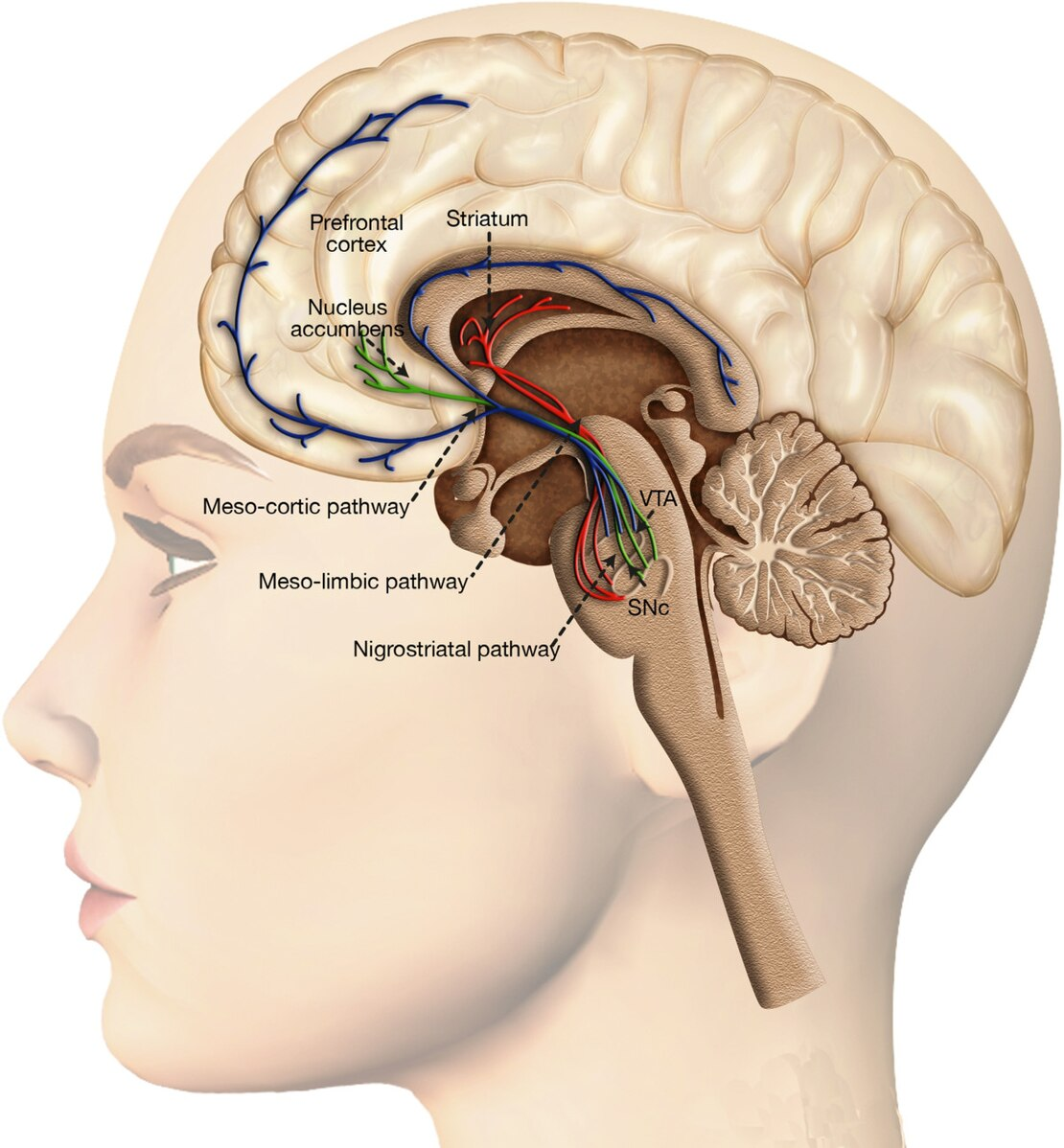
Figure 1. A diagram of some major dopamine pathways and areas impacted by depression.
Works Cited:
[1] Perlman, G., Kotov, R., Wengler, K., Moeller, S. J., Horga, G., Abi-Dargham, A., & Klein, D. N. (2025). Neuromelanin-Sensitive MRI Contrast and Chronic Depression in Young Women. JAMA Network Open, 8(9). https://doi.org/10.1001/jamanetworkopen.2025.33339.
[2] Image retrieved from: https://commons.wikimedia.org/wiki/File:Dopaminergic_system_and_reward_processing.jpg
 Young Investigators Review
