
By Kang Lai 2026
The dorsal striatum is a major input region of the basal ganglia and plays critical roles in goal-directed and habit learning. Neural processes within this region are largely shaped by serotonin, also known as 5-HT. Previous research has shown that monoamines and acetylcholine (ACh) can regulate the release of each other in the striatum. For example, dopamine causes excitation of striatal cholinergic interneurons (CINs) leading to ACh release, which then facilitates dopamine release through nicotinic ACh receptors (nAChR) on nigrostriatal axons. While previous research shows 5-HT directly regulates the activity of the CINs in a region-specific manner, it is unknown whether the release of ACh by CINs can also influence the release of local 5-HT through nAChRs.
Research from the laboratories of Joshua Plotkin and Joshua Goldberg demonstrates that activation of CINs directly triggers local 5-HT release in the dorsal striatum dependent on nAChRs on serotonergic axons. Using an adeno-associated virus, researchers inoculated the dorsal striatum of mice with a fluorescent 5-HT sensor called GRAB-5HT. Electrical stimulation increased the fluorescence signal and was measured by two-photon laser scanning microscopy. A non-selective nAChR antagonist called mecamylamine reduced striatal 5-HT signal, suggesting that nAChR activation is necessary for striatal 5-HT release.
Optogenetic experiments revealed similar results. LED stimulation selectively activated CINs and GRAB-5HT fluorescence recordings revealed an increase in 5-HT. Similar to the results seen using two-photon laser microscopy, GRAB-5HT signal was abolished by mecamylamine further confirming 5-HT release is dependent on nAChRs. Addition experiments ruled out alternative pathways such as postsynaptic nAChRs on GABAergic interneurons, presynaptic nAChRs on glutamatergic inputs, and muscarinic ACh receptors, suggesting that 5-HT release in the dorsal striatum is directly linked to CIN activation. Furthermore, nAChR activation not only increased 5-HT levels but also expanded the spatial extent of 5-HT footprint by 45%.
In Sapap3-/- mice, a common model for obsessive-compulsive disorder, the release of 5-HT due to CIN activation is amplified. Sapap3-/- mice are hypercholinergic therefore exhibit increased CINs and ACh release. As a result, application of intrastriatal electrical stimulation to the dorsal striatum, produced greater GRAB-5HT fluorescence signals, and likewise, this signal was abolished by an nAChR antagonist.
However, the decreased release of 5-HT in the dorsal striatum in the presence of mecamylamine is not mirrored in the ventral striatum. Both the electrical stimulation of AAV-inoculated GRAB-5HT and optogenetic stimulation showed that baseline 5-HT release in the ventral striatum was not affected with the nAChR antagonist. Meaning in the ventral striatum, nAChRs do not contribute to 5-HT release. This study reveals a novel interaction in which cholinergic interneurons and nAChRs regulate dorsal striatum serotonin release, highlighting a potential pathway for further research elucidating brain function, disease, and therapeutics.
Work’s Cited:
1. Matityahu, L., Hobel, Z.B., Berkowitz, N. et al. Synchronous activation of striatal cholinergic interneurons induces local serotonin release. Nat Commun 17, 2278 (2026). https://doi.org/10.1038/s41467-026-70359-6
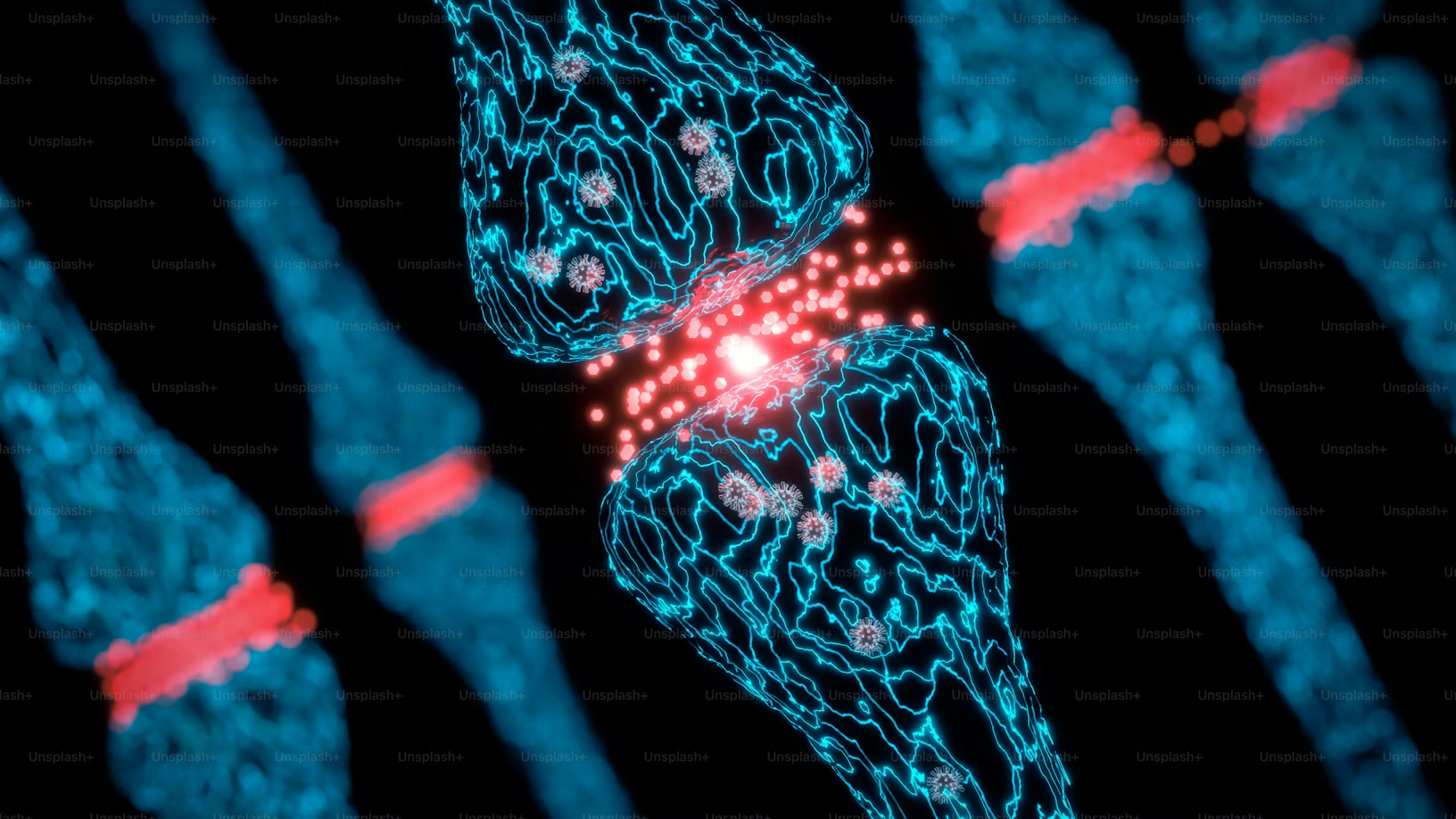
2. Image retrieved from: https://unsplash.com/photos/an-image-of-a-cell-phone-with-a-red-light-on-it-a41ImSZCKlE

