

By Samantha Libbey, Class of 2027

Figure 1: Woman listening to music.
Have you ever described a song as “bright”, or the sound of a violin as “warm”? These are words typically associated with color; however, in some cases they are used to describe sound. But what do these words and their usage reveal about the connection between color and sound? Researchers from the Herberger Institute for Design and the Arts and Ohio State University set out to explore this question. Specifically, they explored whether timbre, or tone color, could predict how listeners associate music with three color properties: lightness, saturation, and warmth-coolness.
The researchers proposed three hypotheses: (1) descriptive words would predict specific color properties, (2) instrument type would influence color choice, and (3) pitch would influence the color choice. They expected sounds rated as “bright” or “high” to have a higher association with lighter, less saturated colors, while sounds described as “sad” or “heavy” were expected to be paired with darker and more saturated colors. In addition, higher pitched recordings were expected to be associated with lighter and less saturated colors.
Two experiments were conducted, where in experiment A, participants listened to musical scales performed at three different pitches across three different keyboard instruments. In experiment B, pitch was held constant while six different orchestral instruments were compared, focusing more on timbre differences. After each recording, participants were asked to rate what they heard according to ten descriptive words and asked to select a color that best described what they heard.
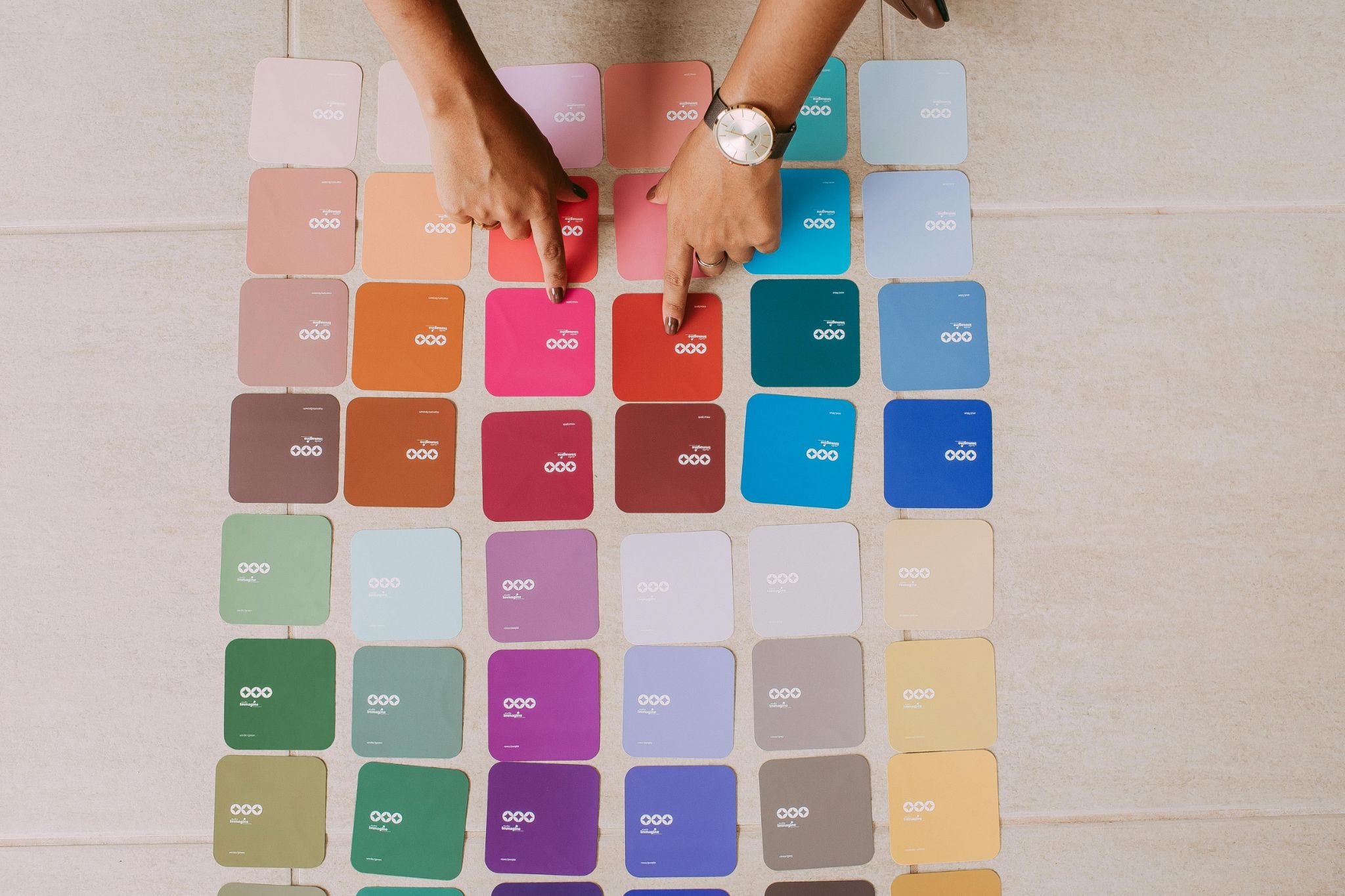
Figure 2: Selection of color palette.
Linear mixed models and ANOVA were used to determine which descriptor ratings and pitch most strongly predicted the saturation of the selected color across both experiments. It was found that higher pitches tended to be paired with lighter colors in part A, while in part B, pitch did not influence the selected color saturation. Unexpectedly, emotional descriptors, such as “sad” were not found to predict any specific color property in both parts. Finally, when pitch was controlled for in Experiment B, instrument type significantly impacted the chosen saturation and warmth-coolness color properties, but not lightness.
Overall, the findings suggest that the association between color and sound is nonrandom, with lightness being the strongest connection between sound and vision. From these results, future research can focus more on how the association between color and sound may relate to music visualization and multisensory integration.
Work’s Cited:
[1] Reymore L and Lindsey DT, “Color and tone color: audiovisual crossmodal correspondences with musical instrument timbre.” Front. Psychol. 15, 1–19 (2025) doi: 10.3389/fpsyg.2024.1520131
[2] Image retrieved from: https://commons.wikimedia.org/wiki/File:Woman_listening_to_music_with_wireless_headphones_neon_light_%2850810419882%29.jpg
[3] Image retrieved from: https://www.pexels.com/photo/cards-with-different-colors-9493105/


