Infectious Diseases may Cause Major Depressive Disorder

By: Marianna Catege Depression may actually be infectious, according to Dr. Turhan Canli, the Associate Professor of Psychology and Radiology at Stony Brook University. His claim puts Major Depressive Disorder (MDD) in a new light, one that suggests it can be caused by parasitc bacterial or viral infections. In this highly prevalent disease, with roughly 7 percent of the U.S. population developing MDD, symptoms can … Continue reading Infectious Diseases may Cause Major Depressive Disorder

Cerebral Blood Flow Imaging Technique Can be Applied to Disease Diagnosis

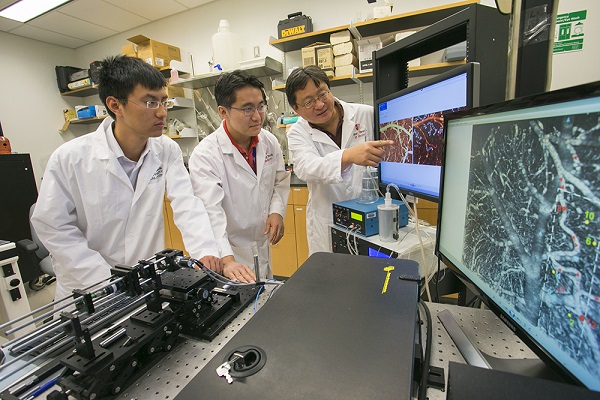
By  Marianna Catege Dr. Yingtian Pan, Professor in the Department of Biomedical Engineering at Stony Brook, and his team, have discovered a new imaging technique that allows for a clearer picture of the direction, speed, and quantity of cerebral blood flow. This discovery expands upon and provides an ultrahigh-resolution picture for Stony Brook Medical scientists’ newly developed method for measuring how cocaine interrupts blood flow … Continue reading Cerebral Blood Flow Imaging Technique Can be Applied to Disease Diagnosis

The Immuno-Matrix Skin Patch: A Needleless Approach to Vaccination

By Preston Kung Kataryzna (Kasia) M. Sawicka, a postdoctoral research associate in the Department of Dermatology, won the national Collegiate Inventors Competition for her “Immuno-Matrix” in November 2014. The Immuno-matrix is a skin patch held together by nanofibers to deliver a vaccine through skin absorption; it’s a needleless vaccination that’s as simple and painless as putting on a Band-Aid. The Immuno-matrix has the potential to … Continue reading The Immuno-Matrix Skin Patch: A Needleless Approach to Vaccination

Mechanisms of General Anesthetics

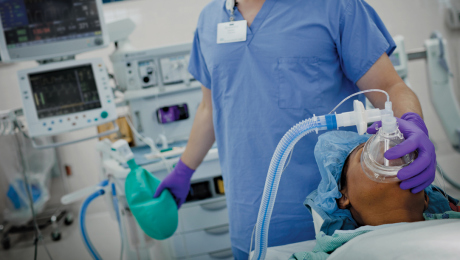
By Sherin Kuriakose What is Anesthesia? The discovery of general anesthetics in 1846 has advanced the work of physicians and surgeons in medical science and clinical care, and has also eased the trauma that surgery can cause for patients. In the past, surgery without anesthesia was the only option, and only the simplest and quickest of operations could be tolerated such as amputations, bladder stones … Continue reading Mechanisms of General Anesthetics

Evaluations of the First Dissolvable Cardiovascular Stent

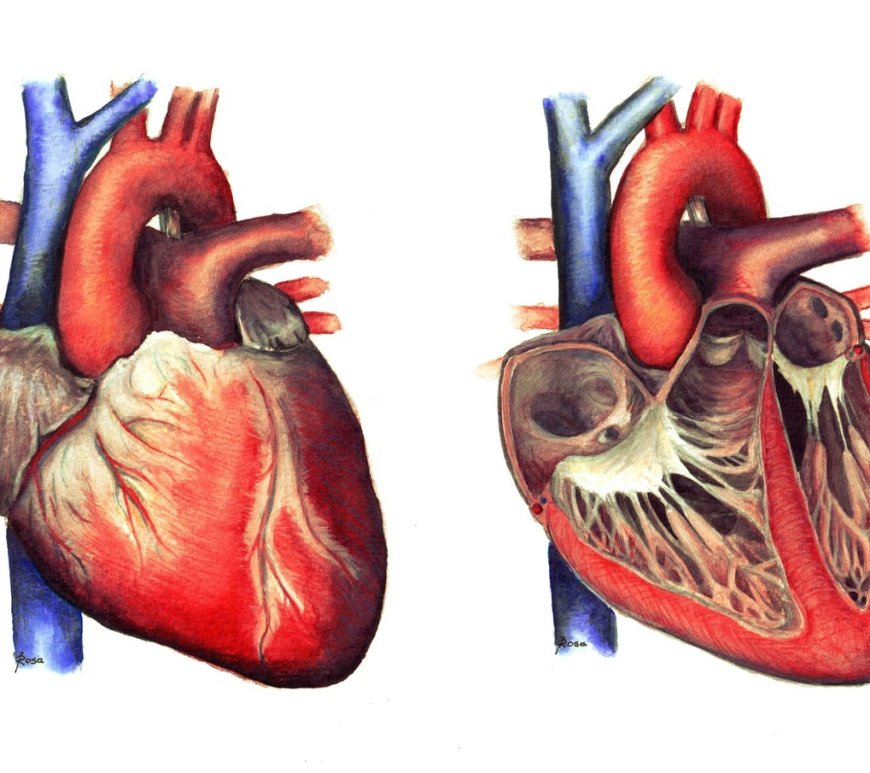
By Jessica Desamero Heart disease in the U.S. is one of the leading causes of death. The most common type is coronary heart disease (CAD), which can lead to heart attacks. It is caused by plaque buildup in arteries that supply the heart with blood, causing them to narrow. To this day, bare-metal stents have been inserted in CAD patients to counter-act this blockage. But … Continue reading Evaluations of the First Dissolvable Cardiovascular Stent

Aristolochic Acid and Chemically Modified Curcumin: an Overview

By Michael Baxter Dr. Francis Johnson received his Ph. D. from Glasgow University in Scotland in 1954 and went on to become a postdoctoral fellow at Boston University until 1957. He worked at the Dow Eastern Research Laboratory before coming to Stony Brook University in 1973, where he became the founding vice-chairman of the Department of Pharmacological Sciences [1]. Currently Dr. Johnson is part of … Continue reading Aristolochic Acid and Chemically Modified Curcumin: an Overview

Aristolochic Acid, used in herbal remedies, linked to urothelial cancers and neuropathic diseases

By Katherine Maiorisi Dr. Grollman of Stony Brook University was honored in 2011 with the Environmental Mutagen Society (EMS) award for his work on aristolochic acid (AA) and its relation to cancer and neuropathy [1]. Throughout the past fifty years studies have been done on the effect of environmental agents on neuropathy. Aristolochia poisoning was first proposed in 1969 by Ivi´c, but was disregarded, until … Continue reading Aristolochic Acid, used in herbal remedies, linked to urothelial cancers and neuropathic diseases