Using Hunger to Suppress Pain

By Marcia-Ruth Ndege ‘21 Much is known about how the brain communicates needs such as thirst, hunger, pain, and fear. However, little is known about how the brain prioritizes such needs. In the context of pain, researchers must examine both acute and inflammatory pain. Acute pain is a reflexive response, while inflammatory pain is mediated by central mechanisms. In research funded by the University of … Continue reading Using Hunger to Suppress Pain

Disease Development Modelled by Induced Pluripotent Cells in 3D Brain Structures

By Marcia-Ruth Ndege ‘21 The rise of three-dimensional brain structures is improving and personalizing medicine by allowing neuroscientists to closely examine the intricacies of the brain. This promising approach is centered around obtaining region-specific 3D brain cultures from individuals and assembling circuits and pathways in the samples. Sergiu Pasca, an assistant professor of Psychiatry and Behavioral Sciences at Stanford Center for Sleep Sciences and Medicine, … Continue reading Disease Development Modelled by Induced Pluripotent Cells in 3D Brain Structures

Ultraconserved Elements Found to Affect Brain Development

By Marcia-Ruth Ndege ’21 In human embryos, the brain begins to develop during the first trimester of pregnancy. Proper brain development is critical at its early stages and could have detrimental effects if something goes awry. Scientists and researchers have investigated and familiarized themselves with the basics of brain development. A new study has shown that an unexpected participant plays a major role in this … Continue reading Ultraconserved Elements Found to Affect Brain Development

Evolution of the Nervous System: Independent or Conserved?

By: Gene Yang ‘19 The question of whether the central nervous system evolved once or multiple times is a subject of much study and debate. Humans and other animals with bilateral symmetry, all of which possess central nervous systems, are known to have descended from a common ancestor. In the past, it was believed that the central nervous system evolved just once in our bilateral … Continue reading Evolution of the Nervous System: Independent or Conserved?

Brain Cells Live and Die in the Process of Learning

By Marcia-Ruth Ndege ’21 For over a century, researchers have pondered the question of how the brain intakes, processes, and retains new information. Researcher Elisabeth Wenger and her team at the Max Plank Institute for Human Development in Berlin, Germany probed deeper into this process by examining the volumetric changes in human grey matter and linking them to the process of skill acquisition in humans. … Continue reading Brain Cells Live and Die in the Process of Learning

Figure 1. The damaging effects of brain-activated inflammation can be mitigated through fasting

The Benefits of Intermittent Fasting

By Matthew Lee ’21 It is well known that distress can have negative effects on both the brain and immune system. Previous studies have established that intermittent fasting (IF) can have positive effects on brain function and possibly on lifespan extension. However, IF was never examined for its potential as a source of eustress. A team of researchers led by Dr. Marjan Shojaie of Hormozgan … Continue reading The Benefits of Intermittent Fasting

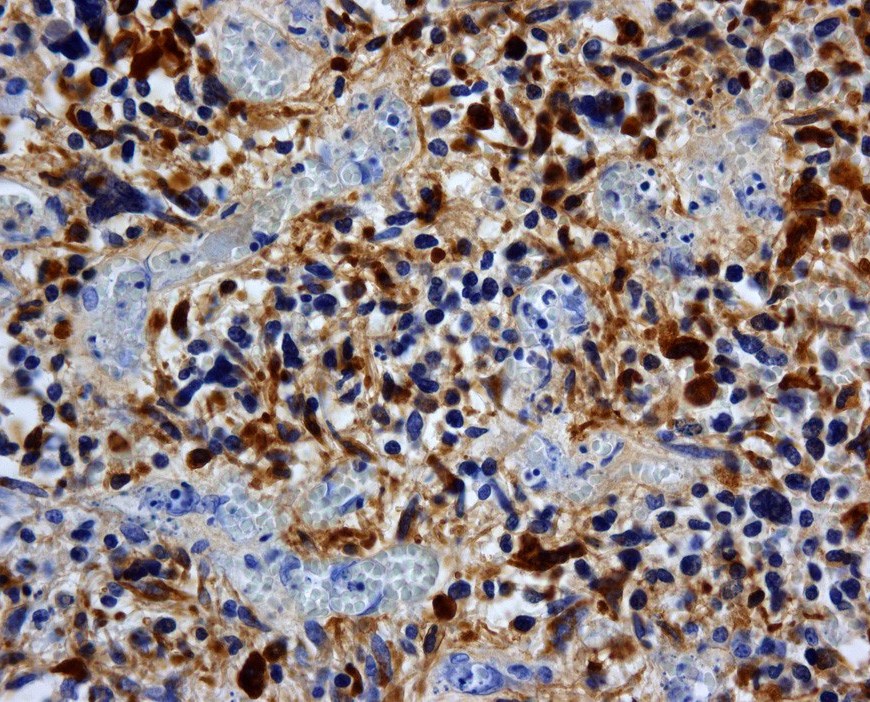
Caption: Glioblastoma cells stained for GFAP proteins.

New Study Shows that Sinomenine Hydrochloride Inhibits Human Glioblastoma Cell Growth

By Melvin Li ’20 Glioblastomas are among the most malignant brain tumors. People diagnosed with them, typically do not have many options for treatment due to the tumors’ abilities to resist apoptosis, or cell death. The tumors tend to grow quickly and are very aggressive; due to the amount of blood supplied to the brain, tumor cells get ample nutrients and growth factors to proliferate. … Continue reading New Study Shows that Sinomenine Hydrochloride Inhibits Human Glioblastoma Cell Growth

Figure 1. Lutein is a naturally occurring pigment found within foods such as kiwifruits. A study from the University of Illinois at Urbana-Champaign suggests that an intake of lutein can reduce cognitive decline in adults.

The Effects of Carotenoids on Cognitive Ability

By Caleb Sooknanan ’20 Lutein — a carotenoid or pigment from green foods such as spinach and kiwifruit — can be quantified in central nervous system tissue, making it a useful way of evaluating diet’s effect on the brain. However, scientists are still determining whether higher lutein amounts yield cognitive ability improvements. Doctor Naiman A. Khan and researchers at the University of Illinois at Urbana-Champaign … Continue reading The Effects of Carotenoids on Cognitive Ability

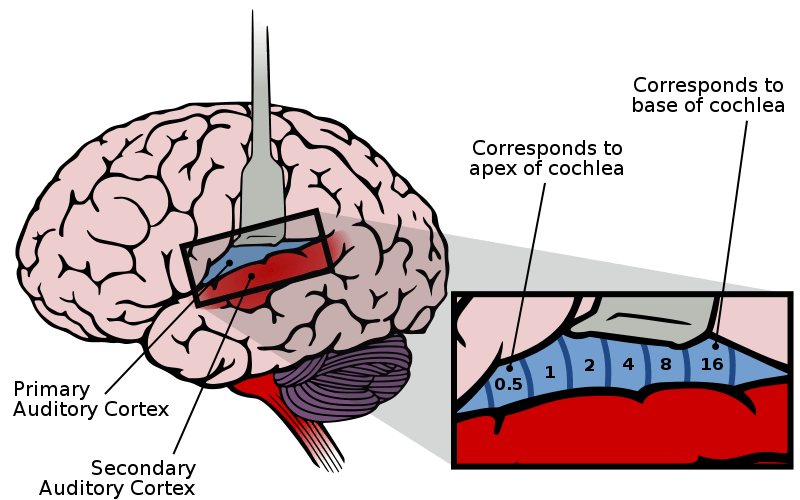
Figure 1: The auditory cortex of the brain highlighted with mapping of sound frequencies.

Restoring Auditory Cortex Plasticity in Adults

By Anna Tarasova ’19 Being able to form, maintain, and strengthen neural connections within the auditory cortex is an important part of language acquisition. Neural plasticity, or the ability of the brain to establish new connections, is especially high in childhood, but decreases with age. A discovery made by Dr. Jay Blundon and his colleagues at the St. Jude Children’s Research Hospital has the potential … Continue reading Restoring Auditory Cortex Plasticity in Adults

Figure 1: Music cues can be utilized for motor learning and can alter brain structure

Music Affects Brain Structure

By Rideeta Raquib ’19 Whether it be going out for a jog or driving a car, our day-to-day physical movements are often coordinated with music. Recently, researchers have harnessed music and employed auditory cues in response to musical stimuli to enhance movement learning and rehabilitation. Previous studies have shown that musicians tend to have a higher fractional anisotropy (FA) values than non-musicians. FA is a … Continue reading Music Affects Brain Structure

Figure 1: Studying, even in older individuals, helps improve cognitive reserves.

Sending Your Grandparents to University Increases Cognitive Reserve: The Tasmanian Healthy Brain Project

Ericka Berman   One way to decrease the likelihood of Alzheimer’s disease is by increasing cognitive reserves (CR). Research supports the idea that education, intelligence, and cognitively stimulating activities modify the risk for dementia. CR is a theoretical construct, so it is measured indirectly. Dr. Megan Lenehan and her team of researchers used data from 459 participants ages 50-79 from the Tasmanian Healthy Brain Project … Continue reading Sending Your Grandparents to University Increases Cognitive Reserve: The Tasmanian Healthy Brain Project

Figure 1. Mammalian brains can be influenced by non-genetic and Allele-Specific expression

Mammalian Brain Affected by Non-Genetic and Allele-Specific Expression

By Rideeta Raquib ’19 The brain is a complex organ that is constantly being impacted by genetic and epigenetic factors. Mental illness patients are usually heterozygous in terms of inheriting one mutant allele. The random inactivation of the X-chromosome and genomic imprinting influences brain architecture and risk of disease. Studies on neuropsychiatric disorders uncovered a spectrum of data regarding the epigenetic dynamics of such dysfunction. … Continue reading Mammalian Brain Affected by Non-Genetic and Allele-Specific Expression