Oral Health May Affect Alzheimer’s Disease

Ellie Teng ‘21 Alzheimer’s disease is a condition that affects millions per year by destroying and reducing mental functions. Dementia, the loss of memory, is a common symptom of this disease. Recent studies have shown a surprising connection between Alzhemer’s and maintaining good oral hygiene. Scientists at the University of Bergen have determined gum disease to be a factor in the development of Alzheimer’s in … Continue reading Oral Health May Affect Alzheimer’s Disease


Augmented Reality Games and Physical Activity: Exploring the Effect of Pokémon Go

Raymond Cheung ‘22 When Pokemon GO was released in 2016, the world was captivated by the ability to capture Pokemon in the real world through augmented reality. An interesting consequence of the game’s popularity is that it promotes physical activity in its players. A recent study conducted by researchers at the University of Tokyo found that the game positively impacted the physical activity in older … Continue reading Augmented Reality Games and Physical Activity: Exploring the Effect of Pokémon Go

Targeted Neurotechnology Can Restore Walking in Humans With Spinal Cord Injuries

By Allan Mai ‘20 Spinal cord injury continues to be a leading cause of paralysis in humans. Depending on the location of the injury, complete or partial paralysis can occur. Fortunately, we live in an age in which advanced neurotechnology such as epidural stimulation is being developed to reverse this condition. In this study, the University of Lausanne’s Dr. Fabien B. Wagner and his team … Continue reading Targeted Neurotechnology Can Restore Walking in Humans With Spinal Cord Injuries

A Novel Approach to Treating Psychopathy Associated with Huntington’s Disease.

By Snigdha Kanadibhotla ‘21 Characterized by uncontrollable and spastic movements, Huntington’s Disease (HD) is a fatal neurodegenerative disorder that is estimated to affect about 1 in 10,000 people in the United States (1). HD has pervasive effects that damage neurons in brain regions associated with mobility, emotion, and intellectual capacity leading to symptoms such as depression, anxiety, and difficulty learning. Despite its complex and varied … Continue reading A Novel Approach to Treating Psychopathy Associated with Huntington’s Disease.

Neurogenesis and its Implications on Brain Development

By Snigdha Kanadibhotla ‘21 Conventionally, humans were thought to be born with a fixed number of nerve cells or neurons that steadily deteriorated over their lifetime; as a result, degenerative brain diseases were thought to be untreatable. However, studies involving animal models have challenged this idea by demonstrating that during adulthood, neurogenesis or the creation of new neurons can occur in the hippocampus which isa … Continue reading Neurogenesis and its Implications on Brain Development

Figure 1. Lutein is a naturally occurring pigment found within foods such as kiwifruits. A study from the University of Illinois at Urbana-Champaign suggests that an intake of lutein can reduce cognitive decline in adults.

The Effects of Carotenoids on Cognitive Ability

By Caleb Sooknanan ’20 Lutein — a carotenoid or pigment from green foods such as spinach and kiwifruit — can be quantified in central nervous system tissue, making it a useful way of evaluating diet’s effect on the brain. However, scientists are still determining whether higher lutein amounts yield cognitive ability improvements. Doctor Naiman A. Khan and researchers at the University of Illinois at Urbana-Champaign … Continue reading The Effects of Carotenoids on Cognitive Ability

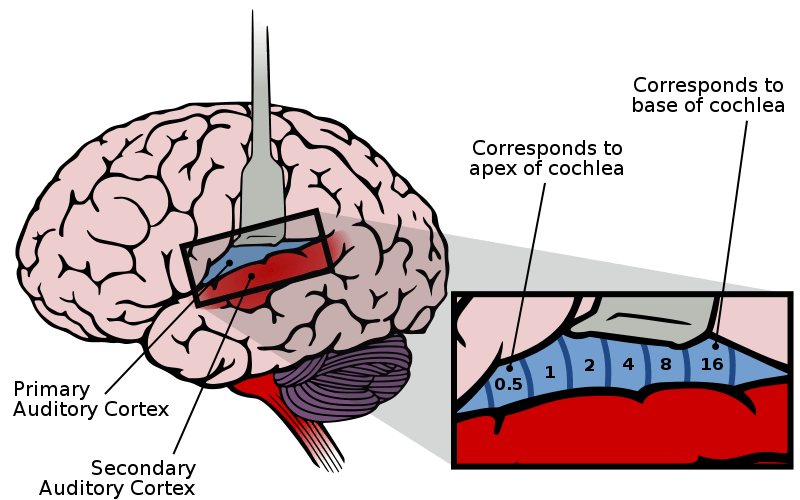
Figure 1: The auditory cortex of the brain highlighted with mapping of sound frequencies.

Restoring Auditory Cortex Plasticity in Adults

By Anna Tarasova ’19 Being able to form, maintain, and strengthen neural connections within the auditory cortex is an important part of language acquisition. Neural plasticity, or the ability of the brain to establish new connections, is especially high in childhood, but decreases with age. A discovery made by Dr. Jay Blundon and his colleagues at the St. Jude Children’s Research Hospital has the potential … Continue reading Restoring Auditory Cortex Plasticity in Adults

Figure 1: Music cues can be utilized for motor learning and can alter brain structure

Music Affects Brain Structure

By Rideeta Raquib ’19 Whether it be going out for a jog or driving a car, our day-to-day physical movements are often coordinated with music. Recently, researchers have harnessed music and employed auditory cues in response to musical stimuli to enhance movement learning and rehabilitation. Previous studies have shown that musicians tend to have a higher fractional anisotropy (FA) values than non-musicians. FA is a … Continue reading Music Affects Brain Structure

Figure 1: Studying, even in older individuals, helps improve cognitive reserves.

Sending Your Grandparents to University Increases Cognitive Reserve: The Tasmanian Healthy Brain Project

Ericka Berman   One way to decrease the likelihood of Alzheimer’s disease is by increasing cognitive reserves (CR). Research supports the idea that education, intelligence, and cognitively stimulating activities modify the risk for dementia. CR is a theoretical construct, so it is measured indirectly. Dr. Megan Lenehan and her team of researchers used data from 459 participants ages 50-79 from the Tasmanian Healthy Brain Project … Continue reading Sending Your Grandparents to University Increases Cognitive Reserve: The Tasmanian Healthy Brain Project

Figure 1. Mammalian brains can be influenced by non-genetic and Allele-Specific expression

Mammalian Brain Affected by Non-Genetic and Allele-Specific Expression

By Rideeta Raquib ’19 The brain is a complex organ that is constantly being impacted by genetic and epigenetic factors. Mental illness patients are usually heterozygous in terms of inheriting one mutant allele. The random inactivation of the X-chromosome and genomic imprinting influences brain architecture and risk of disease. Studies on neuropsychiatric disorders uncovered a spectrum of data regarding the epigenetic dynamics of such dysfunction. … Continue reading Mammalian Brain Affected by Non-Genetic and Allele-Specific Expression

Figure 1. Human skin cells can be converted into homing neural stem cells that deliver treatment directly to brain tumors.

Homing Neural Stem Cells Deliver Direct Cancer Treatment

By Patrick Yang ’20 With average survival for glioblastoma patients at approximately 12-15 months, speed is of essence for glioblastoma cancer treatment. Currently, promising stem cell research has found that neural stem cells naturally migrate towards the chemical signals released by glioblastoma cells. If these neural stem cells are engineered to contain cytotoxic agents, they can deliver cancer treatment directly to cancer cells. However, the … Continue reading Homing Neural Stem Cells Deliver Direct Cancer Treatment

Blunted Neural Response to Rewards as a Prospective Predictor of the Development of Depression in Adolescent Girls

    By Ericka Berman Previous studies have shown that during adolescence, rates of depression increase markedly, and girls tend to have rates of depression twice as high as boys. Depressed adults were also shown to exhibit a decreased behavioral response to a reward and less brain activity in regions associated with reward processing in comparison to healthy adults. Dr. Brady Nelson and his team … Continue reading Blunted Neural Response to Rewards as a Prospective Predictor of the Development of Depression in Adolescent Girls