Humans Remain Behaviorally Responsive to External Auditory Stimuli During Deep Sleep

Author: Vignesh Subramanian, Class of 2024 It has long been assumed that sleep is a stable state of unconsciousness in which an individual cannot perceive and respond to most external stimuli. However, recent studies have indicated that humans can process information, discriminate between basic sensations, and carry out limited executive functions, such as answering yes–no questions, while still asleep. Some oneirological studies have focused on … Continue reading Humans Remain Behaviorally Responsive to External Auditory Stimuli During Deep Sleep


Combined Personological and Motivational Correlates Drive Conspiratorial Ideation

Author: Vignesh Subramanian, Class of 2024 Figure 1: Heightened paranoia and feelings of antagonism towards others are among the strongest indicators of conspiratorial ideation. Conspiracy theories are generally unsubstantiated explanations for specific events or circumstances that attribute said events to powerful individuals or groups secretly working in tandem. It remains disputed that either the number of conspiracy theories or the extent of public belief in … Continue reading Combined Personological and Motivational Correlates Drive Conspiratorial Ideation

Epigenetic Age Acceleration More Accurately Predicts Memory Decline Than Chronological Age

Author: Vignesh Subramanian, Class of 2024 Figure 1: Increasing evidence suggests biological aging, measured by examining the extent of methylation of cells’ DNA, is a stronger predictor of diminishing cognitive abilities than chronological age.  Title: Epigenetic Age Acceleration More Accurately Predicts Memory Decline Than Chronological Age Age acceleration is the term used to describe the difference between an individual’s chronological age, the length of time … Continue reading Epigenetic Age Acceleration More Accurately Predicts Memory Decline Than Chronological Age

Cranial Windows Enable Transcranial Ultrasound Imaging of CSF Disorders

Vignesh Subramanian ’24 Figure 1: A CT scan of a human brain with hydrocephalus, made visible by the enlarged ventricles. Hydrocephalus is a neurological disorder characterized by the abnormal accumulation of cerebrospinal fluid (CSF), the plasma fluid in which the brain is suspended and cushioned, in cavities of the brain known as ventricles. CSF disorders like hydrocephalus develop when CSF is either excessively produced or … Continue reading Cranial Windows Enable Transcranial Ultrasound Imaging of CSF Disorders

The Influence of Epigenetic Age on Cognitive Decline

 Julia Chivu ’23 As people age, their cognitive abilities tend to decline. While chronological age is commonly cited as a reason for this decline, it often fails to explain why some individuals have higher cognitive performance than others of the same age. To address this, epigenetic clocks, which analyze DNA methylation at specific genomic sites correlated with aging, are emerging as useful tools for predicting … Continue reading The Influence of Epigenetic Age on Cognitive Decline

Quantifying Affectionate Touch in Romantic Relationships

Julia Chivu ’23 Across cultures and continents, affection serves as a universal bond that unites romantic partners. Researchers from various institutions worldwide collaborated on two studies to better understand and quantify the dynamic between love and touch. The first study sought to investigate the global association between love and touch-related behaviors. The second study examined the correlation between frequencies of affectionate touch and love amongst … Continue reading Quantifying Affectionate Touch in Romantic Relationships

AD-Linked Proteins Linked to Cognitive Impairment Following 9/11 WTC Exposure

Vignesh Subramanian ’24 Figure 1: The South Pool of the 9/11 Memorial in New York, New York Alzheimer’s disease (AD) is a neurodegenerative disorder characterized by a progressive loss of memory and cognitive thinking skills that typically worsens with age, and is the leading cause of dementia. Key hallmarks of the disease include buildups of two particular proteins – beta-amyloid peptide and phosphorylated tau – … Continue reading AD-Linked Proteins Linked to Cognitive Impairment Following 9/11 WTC Exposure

Chronic Pain Signaling Predicted by Orbitofrontal Cortex Signatures

Vignesh Subramanian ’24 Figure 1: A sagittal MRI view of the human orbitofrontal cortex. Chronic pain syndromes typically entail persistent pain lasting at least three months, marked by the long-term rewiring of neural circuitry that triggers unprompted pain signals. Measuring chronic pain has long proven challenging due to its entanglement with a wide array of overlapping neural circuits and the subjectivity with which it is … Continue reading Chronic Pain Signaling Predicted by Orbitofrontal Cortex Signatures

Where Do We Feel Love?

Julia Chivu ‘ 23 Figure 1  A person looking off to the side while clutching a neon red heart in a dimly lit environment.  Love has compelled psychologists, philosophers, neuroscientists, and other scholars to try and understand its complexities and implications. Researchers from Aalto University sought to understand how 27 different types of love, including parental, romantic, sexual, and religious love, are perceived and experienced … Continue reading Where Do We Feel Love?

PD-Modeling Midbrain Dopamine Loss Diminishes Thalamocortical Signaling

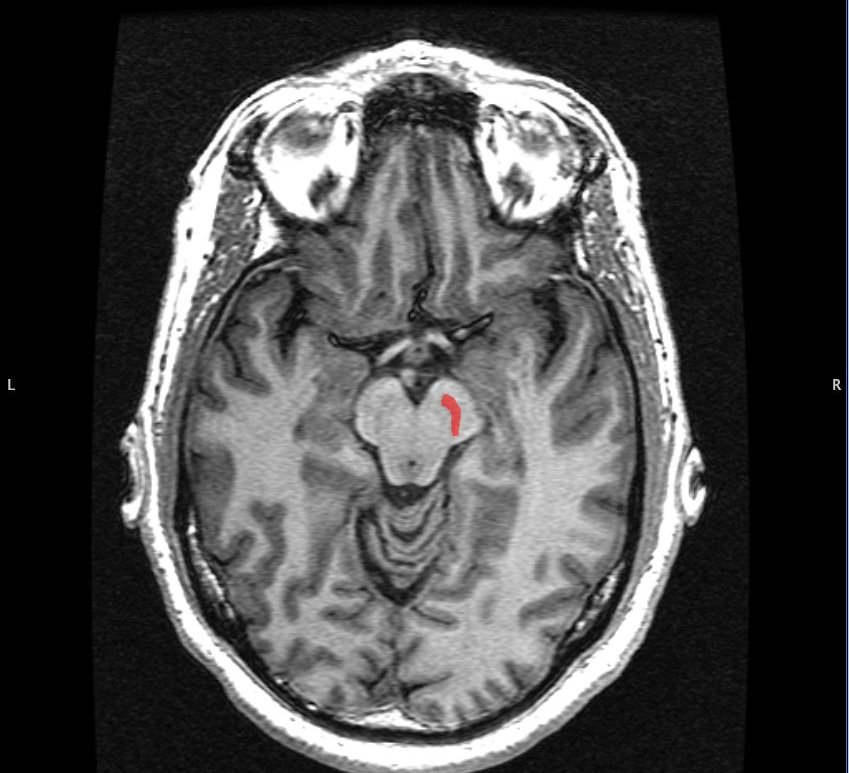
Vignesh Subramanian ’24 Figure 1: The substantia nigra (SN) nucleus in the midbrain. Parkinson’s disease (PD) is an age-related, neurodegenerative movement disorder that causes a progressive loss of motor control. The disease is characterized by a loss of dopaminergic (DA) neurons in the substantia nigra (SN), a midbrain nucleus that modulates movement and reward functions. The SN is one of five subcortical nuclei that make … Continue reading PD-Modeling Midbrain Dopamine Loss Diminishes Thalamocortical Signaling

Maternal Empathetic Cortical Responses Synchronize with Neonatal Pain Perception

Vignesh Subramanian ‘ 24 Figure 1: The heel prick of an infant’s foot, which often induces momentary pain for the infant. The early psychophysical development of newborns relies heavily on having strong emotional bonds with caregivers. Compared to other animals, human infants are born highly dependent on their parents, undergoing a prolonged period of extensive neural organization and brain development that requires greater parental sensitivity … Continue reading Maternal Empathetic Cortical Responses Synchronize with Neonatal Pain Perception

Prairie Vole Monogamy: key in understanding neural underpinnings of love

Jessica George ’24 Figure 1 Prairie voles are small rodents known for their unusual monogamous behavior Love and attachment hold a very important place in human lives but the neuroscience behind them is poorly understood. Recent groundbreaking research involving prairie voles helped to unravel the biological mechanisms behind love and bonding. Prairie voles are small rodents known for their unusual monogamous behavior, forming long-term pair … Continue reading Prairie Vole Monogamy: key in understanding neural underpinnings of love