The Epidemiology and Genetic Diversity of Coxsackievirus A16 in Peru

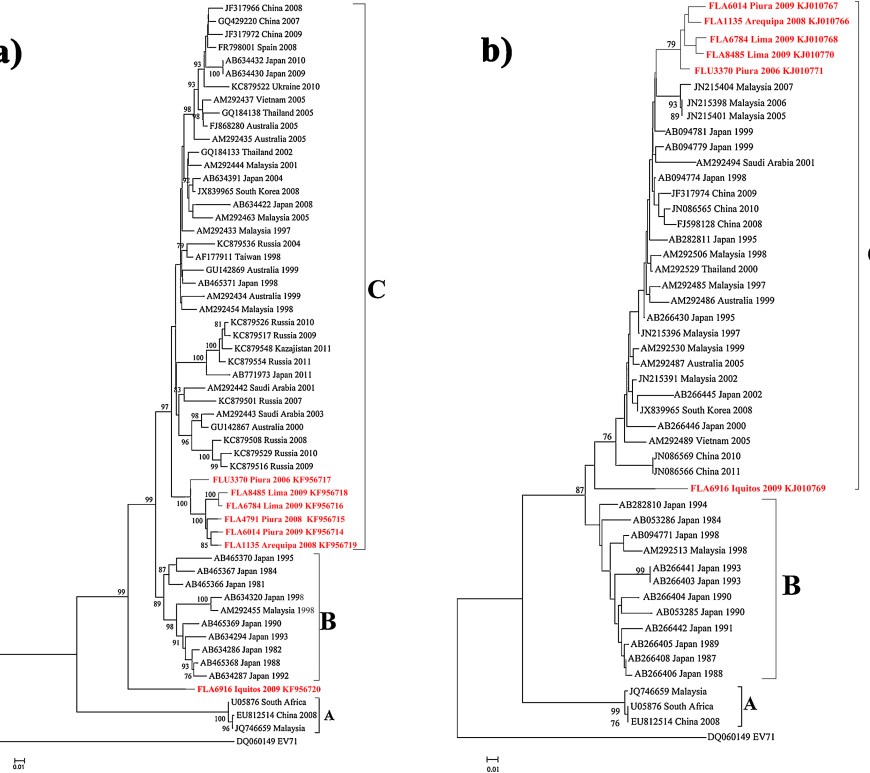
By Caleb Sooknanan These are the most likely trees of coxsackievirus A16 isolates based on the full-length VP1 and VP4 sequences.             Coxsackievirus A16 (CVA16) is an RNA virus that often affects young children and causes rashes and ulcerating blisters. The epidemiology of CVA16 is mostly unknown. Dr. Gladys Carrion and researchers from US Naval Medical Research Unit No. 6 — along with the Peruvian … Continue reading The Epidemiology and Genetic Diversity of Coxsackievirus A16 in Peru

Human Microbiome-Sequenced Data Yields an Antibiotic Candidate

by Jalwa Afroz ’17   Dr. John Chu and a team of researchers at Rockefeller University created a new bioinformatics approach in drug discovery to circumvent the need for bacterial culture and gene expression. Bacterial physiology is limited by the inability to culture most bacteria and also from the gene clusters silenced under lab fermentation conditions. The researchers set out to functionally characterize the data … Continue reading Human Microbiome-Sequenced Data Yields an Antibiotic Candidate

Gold Nanoparticles Suppressing Tumor Growth in Pancreatic Cancer

by Rideeta Raquib ’19   Gold is one of the most valuable resources in the world, and its value may be even greater due to its potential as a new treatment for pancreatic cancer. Previously, gold nanoparticles, AuNPs, were used to target tumor regions and aid in the transport of drugs and chemotherapy to the tumor.  A previous study showed that gold nanoparticles had the ability … Continue reading Gold Nanoparticles Suppressing Tumor Growth in Pancreatic Cancer

Understanding Antigen Replacement in Influenza A Viruses

by Caleb Sooknanan ’20   Influenza is a common viral infection that attacks the respiratory system. Major outbreaks occur due to antigenic changes in the influenza A virus, which is when virus strains from separate hosts combine to form different strains with a mixture of surface antigens. Unfortunately, the mechanism behind this replacement, or antigenic shift, remains misunderstood. Dr. Yuki Furuse and his team of researchers … Continue reading Understanding Antigen Replacement in Influenza A Viruses

New Study Reveals Effects of Timely Hepatitis B Vaccination

by Caleb Sooknanan ‘20   Hepatitis B is a viral infection that often attacks the liver. As infections have become increasingly common in Fujian, China, new measures have been created to control the virus’s impact. Such efforts have included vaccines for newborns and infants, as recommended in China’s national immunization program vaccine (NIPV) series. However, little is known about how the timely administration of the first … Continue reading New Study Reveals Effects of Timely Hepatitis B Vaccination

Effects of Chikungunya Fever on Pregnancies and Newborns

by Caleb Sooknanan ’20   Chikungunya is a mosquito-borne virus that incites severe joint pain and fever. The chikungunya fever (CHIKF) epidemic in Latin and South America in 2013 revealed that the virus posed a threat to maternal and child health. However, information surrounding the risks and effects of mother-to-child transmission of the virus is limited. Dr. Jaime R. Torres and his team of researchers at … Continue reading Effects of Chikungunya Fever on Pregnancies and Newborns

Memory and the Stages of a Women’s Menstrual Cycle

    by Rideeta Raquib Previous psychological studies have suggested that women have a good memory, but a new study implies that this may be due to the impact of hormones. Other studies that tested rodents showed that there was a correlation between low estradiol (E2) levels and an increase in striatal mediated response strategies. The striatum is a region of the forebrain associated with … Continue reading Memory and the Stages of a Women’s Menstrual Cycle

Stem Cells Successfully Generate a Fully Functional Liver

    by Rideeta Raquib Approximately 30 million people are affected by liver disease globally, and the quest to find donors for liver transplants is difficult. There is a lack of functional livers available compared to the liver disease patient population. In some cases, a portion of the liver from a living donor is sufficient for regular function. Stem cells are unspecialized cells that can differentiate … Continue reading Stem Cells Successfully Generate a Fully Functional Liver

Visualizing Microbial Evolution on Antibiotic Landscape

By Jalwa Afroz Bacteria survive by evolving and reproducing in order to overcome environmental challenges. However, there is very little information available on how bacteria physically move in order to attain an environment that is suitable for their needs. Scientists from Harvard Medical School and Technion-Israel Institute of Technology have designed a simple way to show how bacteria move as they become resistant to drugs. … Continue reading Visualizing Microbial Evolution on Antibiotic Landscape

‘Super-agers’ Retain Youthful Memories

  By Jalwa Alfroz As humans age, it is normal for cognitive skills, such as memory, to decline. However, some people seem to escape this fate, and are subsequently categorized as super-agers. Investigators at the Harvard-affiliated Massachusetts General Hospital, led by Dr. Bradford Dickerson, revealed that certain areas of the brains of older adults with extraordinary memory performance looked similar to those of young adults. Previously, … Continue reading ‘Super-agers’ Retain Youthful Memories

A Promising Therapeutic Compound for Huntington’s Disease

By Jalwa Alfroz There is currently no available treatment that can promisingly cure the neurodegenerative disorder Huntington’s disease (HD). HD is a progressive neurodegenerative disorder caused by an inherited defect in a single gene encoding the highly conserved protein, Huntington. It is also an autosomal dominant defect, which means that a person only needs one copy of the defective gene to develop the disorder. The … Continue reading A Promising Therapeutic Compound for Huntington’s Disease

Potential Means of Controlling Fevers

by Richard Liang   The human body is equipped with effective mechanisms that maintain thermal homeostasis. For example, fevers can be induced to provide an optimal environment to fight certain diseases. However, it is vital that fever temperatures are maintained within a particular threshold. They cannot be too low or the energy available for enzyme activity will be too low. They cannot be too high … Continue reading Potential Means of Controlling Fevers