
Skill Issue: The Effect of FPS Games on Cortical Activity

Author: Ishmam Khan, Class of 2025 Figure 1: The FPS genre of gaming has widespread connections around the world, demonstrating its popularity The FPS, or first-person shooter, genre of gaming has a controversial history. In the 1990s, there was a scare regarding the impact such games would have on children. Some worries included, but were not limited to: increased levels of aggression, poor emotional and … Continue reading Skill Issue: The Effect of FPS Games on Cortical Activity

Mature Oligodendrocytes Demonstrate Delayed Cell Death by Alternate Mechanism

By Vignesh Subramanian, Class of 2024 Figure 1: A myelinating oligodendrocyte in a murine brain.  Oligodendrocytes are specialized glial cells in the central nervous system primarily responsible for myelination, the process of ensheathing the axons of neurons in a lipid-rich membrane known as myelin, which insulates the nerve fibers and speeds up the transmission of the action potentials they conduct. Oligodendrocytes are the products of … Continue reading Mature Oligodendrocytes Demonstrate Delayed Cell Death by Alternate Mechanism

Childhood Maltreatment as a Predictor of Neural Activity During Postpartum

Marie Collison, Class of ‘25 Individuals who have experienced childhood maltreatment (CM) in their past have a greater risk of exhibiting behaviors of maltreatment towards their own children. As such, it is important to understand how mothers may respond to their infant cues in context with their past experiences, especially during the often tumultuous postpartum (after-birth) period. Prior research has established that brain responses in … Continue reading Childhood Maltreatment as a Predictor of Neural Activity During Postpartum

Understanding SSRI Withdrawal: Insights Into the Complex Journey

By: Marie Collison, Class of ‘25 Depression is a very common and impairing condition, often resulting in costly care. Selective serotonin reuptake inhibitors (SSRIs) are commonly prescribed as a part of treatment; however, 30–50% of individuals who are prescribed antidepressants do not take them long-term. There are many reasons why a patient may decide to stop taking their medication, such as experiencing negative side effects … Continue reading Understanding SSRI Withdrawal: Insights Into the Complex Journey

Uncovering a Novel Biomarker For The Identification of Parkinson’s-Related Diseases

Author: Sean Krivitsky, Class of 2026 Parkinson’s disease is a severe neurodegenerative disorder most commonly occurring in late adulthood. It is primarily characterized by motor dysfunctions such as uncontrollable tremors and stiffness. Since there is no conclusive test for diagnosis of the disorder, neurologists rely on a comprehensive evaluation system, combining symptoms and physical assessments to gauge the likelihood that an individual has Parkinson’s. A … Continue reading Uncovering a Novel Biomarker For The Identification of Parkinson’s-Related Diseases

Neuroprotective Therapies Capable of Ameliorating Ischemic Injury in Post-Thrombectomy Care

Vignesh Subramanian, Class of 2024 Figure 1: A thrombectomy is a surgical procedure aimed at removing blood clots lodged in an artery of the brain. A stroke is a medical emergency in which blood flow to the brain is disrupted. Strokes may be ischemic (lacking blood supply to brain tissue due to a blocked artery) or hemorrhagic (involving bleeding into the brain tissue due to … Continue reading Neuroprotective Therapies Capable of Ameliorating Ischemic Injury in Post-Thrombectomy Care

Decoding Schizophrenia: Potential Mechanisms of the Schizophrenic Brain Could Lead to Novel Treatments

Author: Kimberly Johnston, Class of 2026 Schizophrenia (SCZ) is a mental disorder characterized by severe impairments in working memory (WM), a type of short-term memory responsible for temporarily storing and manipulating information needed to perform tasks, solve problems, and make decisions. A key region of the brain involved in this process is the medial prefrontal cortex (mPFC), which is active during internal thinking and deactivated … Continue reading Decoding Schizophrenia: Potential Mechanisms of the Schizophrenic Brain Could Lead to Novel Treatments

Humans Remain Behaviorally Responsive to External Auditory Stimuli During Deep Sleep

Author: Vignesh Subramanian, Class of 2024 It has long been assumed that sleep is a stable state of unconsciousness in which an individual cannot perceive and respond to most external stimuli. However, recent studies have indicated that humans can process information, discriminate between basic sensations, and carry out limited executive functions, such as answering yes–no questions, while still asleep. Some oneirological studies have focused on … Continue reading Humans Remain Behaviorally Responsive to External Auditory Stimuli During Deep Sleep

Cranial Windows Enable Transcranial Ultrasound Imaging of CSF Disorders

Vignesh Subramanian ’24 Figure 1: A CT scan of a human brain with hydrocephalus, made visible by the enlarged ventricles. Hydrocephalus is a neurological disorder characterized by the abnormal accumulation of cerebrospinal fluid (CSF), the plasma fluid in which the brain is suspended and cushioned, in cavities of the brain known as ventricles. CSF disorders like hydrocephalus develop when CSF is either excessively produced or … Continue reading Cranial Windows Enable Transcranial Ultrasound Imaging of CSF Disorders

AD-Linked Proteins Linked to Cognitive Impairment Following 9/11 WTC Exposure

Vignesh Subramanian ’24 Figure 1: The South Pool of the 9/11 Memorial in New York, New York Alzheimer’s disease (AD) is a neurodegenerative disorder characterized by a progressive loss of memory and cognitive thinking skills that typically worsens with age, and is the leading cause of dementia. Key hallmarks of the disease include buildups of two particular proteins – beta-amyloid peptide and phosphorylated tau – … Continue reading AD-Linked Proteins Linked to Cognitive Impairment Following 9/11 WTC Exposure

Chronic Pain Signaling Predicted by Orbitofrontal Cortex Signatures

Vignesh Subramanian ’24 Figure 1: A sagittal MRI view of the human orbitofrontal cortex. Chronic pain syndromes typically entail persistent pain lasting at least three months, marked by the long-term rewiring of neural circuitry that triggers unprompted pain signals. Measuring chronic pain has long proven challenging due to its entanglement with a wide array of overlapping neural circuits and the subjectivity with which it is … Continue reading Chronic Pain Signaling Predicted by Orbitofrontal Cortex Signatures

PD-Modeling Midbrain Dopamine Loss Diminishes Thalamocortical Signaling

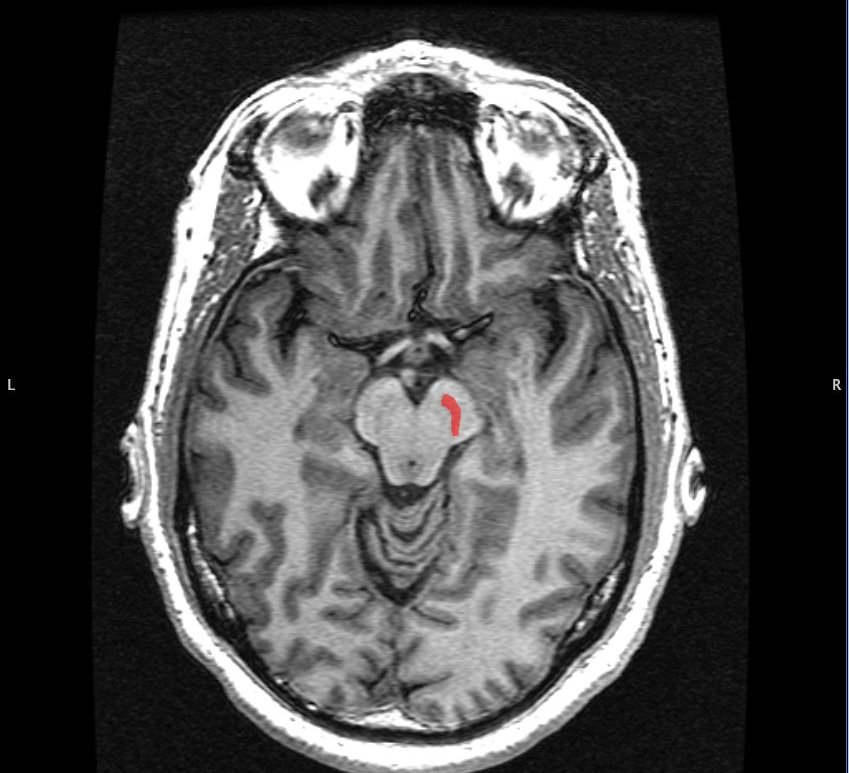
Vignesh Subramanian ’24 Figure 1: The substantia nigra (SN) nucleus in the midbrain. Parkinson’s disease (PD) is an age-related, neurodegenerative movement disorder that causes a progressive loss of motor control. The disease is characterized by a loss of dopaminergic (DA) neurons in the substantia nigra (SN), a midbrain nucleus that modulates movement and reward functions. The SN is one of five subcortical nuclei that make … Continue reading PD-Modeling Midbrain Dopamine Loss Diminishes Thalamocortical Signaling